
Halal Careers in Finance and Tech: Navigating Riba in the Modern Workplace
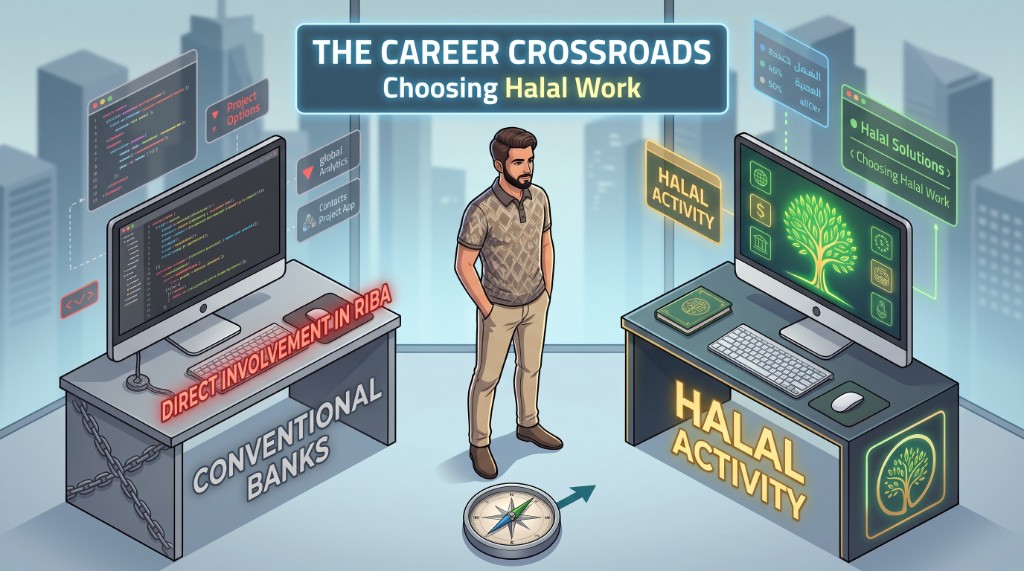
Many Muslim professionals in fields like finance, software development, and cybersecurity face a common dilemma: How do we navigate the modern corporate world without compromising our religious principles regarding Riba (interest)?
At Uswah, we believe that understanding the Islamic rulings around employment is the first step toward building a blessed and successful career. Here is a comprehensive guide to understanding the boundaries of working in financial institutions and companies that deal with interest.
1. The Core Issue: Direct vs. Indirect Involvement in Riba
When looking at jobs within the financial sector, Islamic scholars differentiate between the specific role of the employee and the core business of the institution.
Direct involvement (e.g., investment bankers, loan officers): Preparing, negotiating, or signing interest-based loans is strictly forbidden. The Prophet Muhammad (peace be upon him) cursed the one who consumes Riba, the one who pays it, the one who writes it, and the two witnesses, stating they are all equal in sin.
Indirect involvement (e.g., software developers, cybersecurity experts): Writing code or protecting data is a halal skill. However, if a developer builds databases or security systems for a conventional bank, they are providing the essential tools the bank needs to run its Riba operations. This falls under the prohibition of cooperating in sin, as stated in the Quran: "And cooperate in righteousness and piety, but do not cooperate in sin and aggression."
2. What if the Software is Only for Internal Management?
A common question is whether building an internal management system (like an HR portal) for a conventional bank is permissible, since it does not process Riba directly.
The majority of contemporary scholars state that this remains impermissible. A conventional bank is an institution fundamentally built to trade in Riba. Building internal infrastructure helps the bank's employees perform their duties efficiently, thereby keeping the entire Riba-based system running smoothly. It remains a form of indirect assistance to a prohibited core business.
3. Halal Core Business vs. Haram Core Business
In the modern global economy, almost every major company has bank accounts that may generate interest or takes loans to expand. Does this mean Muslims cannot work anywhere?
Islam is a practical religion built on removing hardship. Scholars make a clear distinction between two types of entities:
- Haram core business (e.g., conventional banks): The primary product being sold is Riba. Working here, even in IT or marketing, is not permitted.
- Halal core business (e.g., tech, healthcare, retail, education): If a company sells software, clothes, or medical equipment, but the owners take an interest-based bank loan to fund operations, working for this company is completely halal. The sin of the loan falls entirely on the directors who signed it. As long as your specific daily tasks do not involve processing or signing those interest contracts, your income is halal.
4. Global Halal Alternatives for Finance Professionals
For those passionate about investment banking, wealth management, and corporate finance, the Islamic finance sector is booming globally. Professionals can build robust careers in these institutions without compromising their faith.
Australia
- Salaam
- Hejaz Financial Services
- MCCA
- BARAQAH Islamic Finance
- Ijarah Finance
Arab World
- Al Rajhi Bank (Saudi Arabia)
- Dubai Islamic Bank (UAE)
- Kuwait Finance House (KFH)
- Qatar Islamic Bank (QIB)
- Faisal Islamic Bank (Egypt)
UK & Europe
- Al Rayan Bank (UK)
- Gatehouse Bank (UK)
- KT Bank (Germany)
Navigating the job market requires diligence, but the global economy offers abundant halal opportunities. Seeking a pure income brings blessing (Barakah) to one's wealth, family, and life. As the Prophet (peace be upon him) promised, leaving something for the sake of Allah always results in something far better.
Frequently asked questions
- Is building internal HR software for a conventional bank permissible?
- Most contemporary scholars hold it is not permissible, because it supports an institution whose core business is riba.
- Can a Muslim software developer work at a tech company whose owners took an interest-based loan?
- If the company’s core business is halal (software, retail, healthcare, etc.) and your daily work does not handle riba contracts, many scholars permit employment; the sin of the loan rests on those who contracted it.
- What counts as direct involvement in riba at a bank?
- Roles that structure, negotiate, approve, or document interest-based loans—such as investment banking or loan officers—are directly involved and are not permissible.
- Where can Muslims look for halal employers in finance and tech?
- Seek firms whose core activity is halal, Islamic finance institutions with Sharia boards, and tech or professional services outside riba-based banking—while verifying your role does not enable prohibited contracts.
This article is for general education only and does not replace personal fatwa. For your own situation, message us on WhatsApp or email us.