
The Illusion of Money: From Solid Gold to the Debt Trap and the Islamic Solution
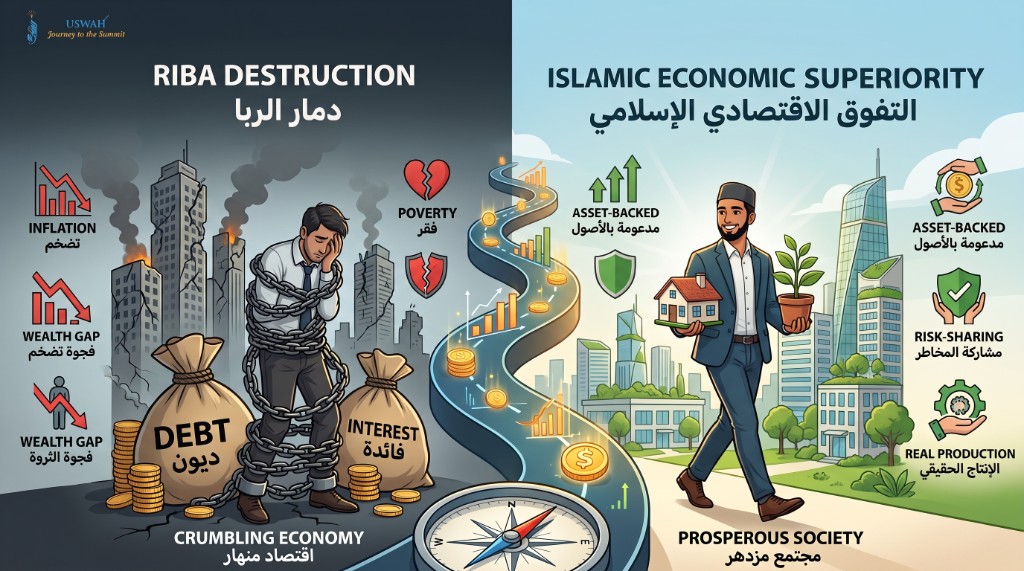
We live in a world driven by endless cycles of debt and complex financial engineering. Entire nations declare bankruptcy, and individuals spend their lives paying off never-ending interest. How did money transform from a tool for exchanging value into an instrument of economic enslavement? To understand the brilliant solution offered by the Islamic economic system, we must first rewind time and read the "story of money."
Chapter 1: The Golden Era & The Birth of the Deception
In the past, financial transactions relied on "real money"—gold and silver. The currency carried its intrinsic value; a gold dinar was valuable everywhere. In that era, the "institutional inflation" we see today did not exist. Inflation was rare and natural, occurring only if the supply of physical gold suddenly increased. The economy remained stable and tied to actual production.
Riba (usury/interest) is not a modern invention. Its earliest forms appeared in ancient Mesopotamia (like Babylon) when lenders loaned seeds to farmers and demanded a larger return. However, the great deception that founded the modern banking system began in Europe with the "Goldsmiths."
People used to deposit their gold with goldsmiths for safekeeping in exchange for a paper receipt. The goldsmiths noticed that people rarely withdrew their physical gold, opting instead to trade the paper receipts. Realizing this, goldsmiths began issuing paper loans far exceeding the actual gold in their vaults, charging "interest" on this phantom money. This was the birth of "Fractional Reserve Banking"—where banks literally create money out of thin air and lend it out on interest.
Chapter 2: The Great Shock and American Dominance
In 1944 (the Bretton Woods Agreement), the world agreed to peg their currencies to the US Dollar, and America promised to peg the Dollar to gold ($35 per ounce). The world trusted this, handing over their gold and keeping paper dollars.
However, America began printing dollars to fund wars, far exceeding its gold reserves. When countries like France demanded gold for their dollars, US President Richard Nixon delivered a global shock in 1971: he completely severed the Dollar's link to gold. Paper money became purely "fiat"—backed by nothing but trust in the government.
To save its currency, America struck a historic deal with Saudi Arabia and OPEC in 1974: "We will provide military protection, provided you only sell oil in US Dollars." Thus, the "Petrodollar" was born. The entire world was forced to acquire Dollars to buy energy, granting America control over the global economy without needing an ounce of gold.
Chapter 3: The "Interest Rate" Weapon & The Global Web
With the Dollar dominating, the US Federal Reserve began controlling the world using a powerful, dangerous tool: Interest Rates (which is the essence of Riba).
Lowering Rates (Opening the Faucet): Loans become cheap. People and companies borrow and spend heavily. The market booms, but because of the excess printed money, prices skyrocket, causing "Inflation."
Raising Rates (Closing the Faucet): To kill inflation, the Fed raises rates. This triggers a catastrophe for developing nations. Investors pull their billions out of emerging markets to deposit them in US banks for high, guaranteed returns. Local currencies collapse, import prices surge, and local central banks are forced to raise their rates to astronomical levels (e.g., 20% or 30%), which kills local investment and bankrupts businesses.
The Interconnected Web:
- Dollar vs. Gold: They are enemies. If the US raises rates, investors flock to the Dollar, and gold prices drop. If rates drop or crises occur, people lose faith in fiat currency and buy gold (the ultimate safe haven), causing its price to soar.
- Dollar vs. Oil: Oil is priced in Dollars. A strong Dollar means developing nations must spend massive amounts of their weakening local currency just to buy basic energy, plunging them further into inflation.
Chapter 4: Trade vs. Riba — Light vs. Darkness
In this phantom system, Riba became the engine. This brings us to the ancient misconception mentioned in the Quran: "That is because they say, 'Trade is [just] like interest.' But Allah has permitted trade and has forbidden interest."
Riba (Interest): Exchanging money for money with a guaranteed increase. The lender exerts no effort, takes no risk, and always wins, even if the borrower goes bankrupt. This destroys the economy because it adds no real production value.
Trade (Halal): Exchanging money for a good or service. The merchant takes the risk of ownership and exerts effort. The golden Islamic rule is "Al-Ghunm bil-Ghurm" (yield is justified by the risk taken), which builds a resilient, real economy.
Chapter 5: Practical Islamic Solutions to Modern Traps
Islam never forbids something harmful without providing a pure, practical alternative:
1. The Alternative to Interest for Beating Inflation
In capitalism, you put money in a bank for fixed interest to beat inflation (which is Riba). In Islam, a loan is an act of charity (Qard Hasan) and must be returned exactly as is. To protect and grow your wealth, you must inject it into the real economy through "Mudarabah" (profit-sharing partnerships) in trade/industry, or by purchasing tangible assets (real estate, gold). Wealth grows organically as the actual economy grows.
2. The Alternative to "Late Fees"
Charging a financial penalty that goes into the lender's pocket is strictly forbidden. To secure rights, Islam allows taking Collateral (Pledge) (selling an asset if the debtor defaults) or requiring a Guarantor. Modern Islamic banks use a "Charity Penalty Clause" to deter wealthy individuals from delaying payment. The defaulter pays a penalty, but it never enters the bank's profits; the bank is legally obligated to donate it to charity.
3. Alternative to Car Loans — Murabaha
- Haram: The bank lends you $10,000 to buy a car and you pay back $12,000. (Money for money with increase).
- Halal: The Islamic bank buys the car, owns it, and assumes its risk. Then, it sells the car to you for $12,000 in installments. (Legitimate trade of an asset).
4. Alternative to Mortgages — Diminishing Musharakah (Ijarah)
- Haram: The bank lends you money at interest and puts a lien on the house. (Exploitative Riba).
- Halal: You and the bank buy the house together (e.g., you 20%, the bank 80%). The bank leases its share to you. Your monthly payment includes rent plus a portion to buy the bank's shares. Over time, your ownership increases, your rent decreases, until you own 100% of the house. (Partnership, leasing, and risk-sharing).
Conclusion
The Islamic economic system is not just a set of religious texts; it is a comprehensive framework that protects humanity from phantom debt bubbles. When Riba is replaced by Trade and Partnership, the economy shifts from digits on a screen controlled by a few massive banks, into a real, asset-backed economy that distributes wealth fairly and ensures sustainable prosperity for all.
Frequently asked questions
- What is the Islamic alternative to putting money in a bank for interest to beat inflation?
- Islam treats a loan as Qard Hasan (return the same amount). To protect wealth from inflation, scholars direct Muslims toward real-economy participation—Mudarabah (profit-sharing), tangible assets like gold or property—not fixed riba returns.
- Is Murabaha just a disguised interest loan for buying a car?
- In a proper Murabaha, the bank buys and owns the car first, bears ownership risk, then sells it to you at a disclosed markup in installments. That is trade in an asset, not money-for-money with guaranteed increase.
- How does diminishing Musharakah differ from a conventional mortgage?
- You and the bank co-own the home. You pay rent on the bank’s share plus payments to buy out its equity over time—partnership and lease, not a riba loan secured on the house.
- Why do Islamic banks use a charity penalty instead of late fees for the bank?
- A late fee that enriches the lender is riba. A charity penalty deters delay while ensuring the bank does not profit from the delay—the amount goes to the poor.
- Does fractional reserve banking relate to riba in Islam?
- Creating credit beyond real gold backing and lending it with interest is a root of modern riba-based systems. Islamic finance instead ties gain to trade, shared risk, and asset-backed contracts.
This article is for general education only and does not replace personal fatwa. For your own situation, message us on WhatsApp or email us.